
The Ultimate Guide to Hardscaping in Glendale, CA: Rain Barrel Ideas for Gardens and Trees
Glendale is a place where hardscape decisions show up quickly in the health of a garden. A patio that sheds water too fast, a walkway that traps heat, a side yard poured wall to wall in concrete, each one changes how plants survive through hot summers and mild winters. The city’s own water-saving guidance points residents toward California-friendly and California native plants because they fit this climate better than thirsty turf and high-maintenance ornamentals. That same guidance also makes a practical point many homeowners already feel on their water bills: outdoor watering is a major part of residential water use, so better landscape planning matters.
Rain barrels belong in that conversation, not as a novelty tucked behind a garage, but as part of a broader water wise landscaping strategy. Used thoughtfully, they support trees, garden beds, and drought tolerant landscaping while reducing the demand on irrigation systems. They also force a useful design question: where does water move on your property after it lands on the roof, driveway, patio, or slope?
Hardscaping in Glendale is not just about stone, pavers, decorative rock, gravel landscaping, retaining edges, and outdoor rooms. It is about permeability, shade, soil preparation, plant selection, maintenance, and the small choices that decide whether a yard becomes cooler and more resilient or hotter and harder to care for. A rain barrel is a modest object, but it can reshape the way you think about the whole site.
Why rain barrels make sense in Glendale landscapes
Glendale Water & Power encourages rainwater use through rain barrels as a conservation practice for gardens and trees. The reason is straightforward. A meaningful share of the city’s potable water goes toward landscaping, and every gallon used from stored rainfall is a gallon not pulled from the tap for outdoor irrigation.
That does not mean a rain barrel replaces a well-designed irrigation plan. Glendale’s dry periods are long enough that stored rainwater should be treated as a supplement, not the backbone of the entire landscape. The better approach is to pair rain barrels with drought tolerant landscaping, drip irrigation, mulching, and native California plants that need less frequent watering once established. Glendale’s water-saving guidance specifically recommends checking irrigation systems for leaks, using drip irrigation, adding mulch, and watering at cooler times of day. Rain barrels fit neatly beside those practices.
The biggest mistake I see in water wise landscaping is treating each feature as separate. A homeowner installs synthetic grass in one area, decorative rock in another, a few shrubs near the house, and then maybe a barrel under a downspout. Nothing is technically wrong, but the landscape does not function as a system. A stronger design looks at the roof, the grade, the soil, the planted areas, the shade pattern, and the maintenance routine together. The rain barrel becomes one piece of a connected plan.
Hardscape first, but not hardscape alone
Hardscaping usually comes before planting because it defines how people move through the yard and how water moves across it. In Glendale, that sequence matters. The city’s single-family landscaping guidance encourages native or drought-tolerant planting and says site design should maximize water permeability by reducing paved areas. That principle is easy to support on paper and harder to execute in a narrow side yard, a sloped lot, or a front yard that has been paved over for years.
Good landscape design starts by asking what must be solid and what can breathe. A main entry walk needs stable footing. A seating area needs enough flat surface for furniture. A driveway needs to perform. But the spaces between those features often do not need to be sealed. Gravel landscaping, permeable joints, planting pockets, and mulched basins can soften the impact of hardscape while making room for water to enter the soil.
This is where rain barrel planning becomes useful even before you buy the barrel. Follow the downspouts. Watch where roof runoff currently goes. Does it rush across a walkway? Does it collect near a foundation? Does it disappear into a drain before it ever helps the landscape? Does the patio slope toward a planting bed or away from it? Those observations often reveal low-cost improvements that matter more than another decorative feature.
For example, a front yard landscaping project in Glendale might replace tired turf with a path, gravel mulch, California-friendly shrubs, and a landscaping Glendale Ridgeline Outdoor Living small tree. If the downspout already lands near that area, a rain barrel can help establish the new planting during its early years. The hardscape can be shaped so overflow moves toward planted soil rather than across pavement. The result looks intentional, but more important, it works.
Designing with barrels instead of hiding them
Many homeowners begin with the assumption that a rain barrel is unattractive and must be concealed. Sometimes that is true. A barrel placed randomly against a visible wall can look like an afterthought. But with a little landscape planning, it can become visually quiet, even elegant.
The best placements are near downspouts, near the plants that will use the water, and on stable hardscape. Those three needs can compete. A downspout may be at the front corner of the house, while the thirstiest tree is in the back. A barrel may be convenient in a side yard, but the side yard may be too narrow for comfortable access. A beautiful spot may be impractical because carrying water from it becomes annoying after the first few weeks.
Professional garden design always has to respect habits. If a feature is awkward to use, it will stop being used. For rain barrels, convenience matters more than perfection. A slightly less hidden barrel that is easy to reach will do more good than a perfectly screened one buried behind dense shrubs.
Hardscape can help with the visual problem. A small pad of pavers can make the barrel feel placed rather than dumped. A low screen that matches a fence can soften the view. Decorative rock around the base can keep the area clean, though it should not replace mulch where plants need soil cooling and moisture retention. In modern landscaping, a simple barrel, a clean gravel edge, and drought-tolerant planting can look more appropriate than a fussy disguise.
The barrel should also relate to the architecture. Glendale has a mix of home styles, and a rainwater feature that works beside a modest bungalow may not suit a more formal facade. The goal is not to turn the barrel into Landscape community guide a focal point unless the design calls for it. Often the goal is to make it read as part of the service layer of the landscape, like a hose bib, gate, or utility path, neat, accessible, and unobtrusive.
Gardens and trees use rainwater differently
A vegetable-style garden, an ornamental bed, and a tree basin do not all benefit from stored rainwater in the same way. Glendale’s guidance emphasizes water-wise plants, native plants, and landscapers Glendale CA low-water irrigation techniques, and the city notes that native plants can survive drought with far less water than turf. That does not mean every plant should be watered the same way. Plant selection and watering method need to match.
Trees generally benefit from deeper, less frequent watering than shallow-rooted annuals or small perennials. A rain barrel can be especially useful for young trees during establishment, provided the water is applied slowly to the root area rather than splashed at the trunk. A basin with mulch helps hold that moisture. The mulch also supports the broader water-saving guidance Glendale promotes, because covered soil loses less moisture and is easier to manage.
Garden beds often need more frequent attention, especially when newly planted. For drought tolerant landscaping, the early period after installation is the most delicate. Even California native plants and California-friendly plants may need regular care while roots settle into the soil. Stored rainwater can help during that phase, but the long-term goal should still be a landscape that relies on efficient irrigation systems, appropriate planting, and seasonal restraint.

This is one of the trade-offs in low maintenance landscaping. People sometimes assume low-water plants require no care. In practice, the maintenance changes rather than disappears. You may mow less or stop mowing entirely after turf removal, but you still need to check drip emitters, renew mulch, prune at the right time, and keep weeds from taking advantage of open gravel or disturbed soil. Glendale’s turf-replacement messaging is blunt about turf needing weekly care, which is one reason many homeowners consider lawn alternatives. But a water wise garden still asks for observation.
Replacing thirsty lawn with a rain-smart hardscape
A lot of landscape renovation in Glendale begins with a tired lawn. The owner is tired of lawn care, the water bill is too high, or the grass looks good for a short season and stressed the rest of the year. Sod installation still has its place in some landscapes, particularly where active use is real and frequent, but turf should earn its square footage. If a lawn is only being looked at, not used, there are often better options.
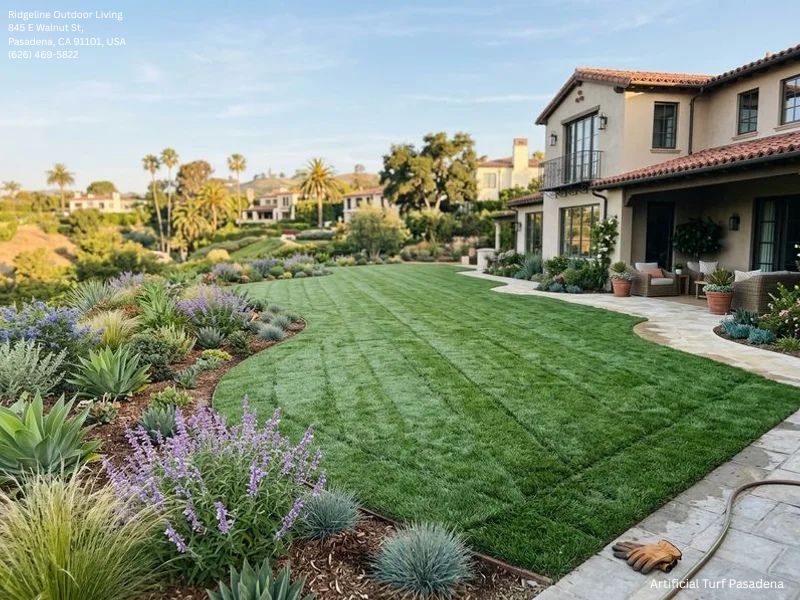
Artificial turf and synthetic grass enter the discussion here, especially for small yard landscaping or play areas. They reduce irrigation for that specific surface, but they do not provide the same ecological function as living planting, and they do not solve the entire heat or permeability question by themselves. A balanced design may use no turf at all, or it may keep a small functional lawn while replacing the rest with drought tolerant landscaping, native California plants, and permeable hardscape.
When a front yard or backyard landscaping project removes turf, the opportunity is larger than a plant swap. The grades can be adjusted. The irrigation systems can be converted or simplified. Soil preparation can be done before decorative rock or mulch goes down. Downspouts can be directed toward barrels or planted basins. A path can be placed where people actually walk, rather than where the old lawn happened to leave a worn track.
A useful turf-to-water-wise renovation often includes these decisions:
That is one of the two moments where a short list helps, because the decision sequence matters. If you start with decorative rock before solving irrigation and grading, the project becomes harder to correct later. If you set the rain barrel before deciding where the plants will be, the barrel may end up serving the wrong part of the yard.
Permeability is the quiet measure of success
Permeability is not always glamorous, but in Glendale hardscaping it is one of the most important performance measures. The city’s guidance for single-family areas points directly to reducing paved areas and maximizing water permeability. That does not require every yard to look rustic or unfinished. It means being selective with solid surfaces.
A fully paved backyard can be easy to sweep, but it usually pushes water away from the soil and can make the space feel hotter. A yard with carefully placed hardscape, gravel areas, mulched planting beds, and shade has more resilience. Water has somewhere to go. Roots have room. The garden looks less brittle during hot periods because the design is not fighting the climate.
Gravel landscaping can be effective when used correctly. It is especially useful for paths, service areas, and modern landscaping compositions where clean lines matter. But gravel is not a magic water-saving product. If laid over compacted soil with no planting strategy, it can become a hot, weedy surface. Decorative rock around drought-tolerant shrubs may look tidy, but organic mulch often performs better for soil moisture and temperature around many plants. The right choice depends on the location, the plant palette, and the desired maintenance routine.
Mulching deserves more respect than it gets. Glendale’s water-saving tips include adding mulch, and for good reason. Mulch moderates soil temperature, slows evaporation, and reduces weed pressure. In a rain barrel plan, mulch helps the captured water stay useful longer after it is applied. Without mulch, a small amount of stored water can disappear quickly from exposed soil during warm weather.
Rain barrels and irrigation systems should cooperate
A common misconception is that rain barrels and irrigation systems are competing approaches. In Glendale, they should usually cooperate. Drip irrigation provides reliable, efficient watering when rainwater is not available. Rain barrels provide supplemental water when rainfall has filled them. Together, they reduce waste and improve flexibility.
The practical issue is management. If the irrigation schedule continues unchanged while stored rainwater is also being applied, the landscape may receive more water than intended. Water wise landscaping requires attention, not just equipment. Glendale recommends watering before 9 a.m. Or after 6 p.m., checking irrigation systems for leaks, and watering landscape only one day a week in winter. Those habits matter whether the water comes from a municipal line or a barrel.
For a homeowner, the simplest rhythm is to use barrel water by hand on priority plants: young trees, newly installed native plants, or a garden bed that dries faster than expected. That approach avoids overcomplicating the system. More elaborate setups can be tempting, but complexity is not always an advantage in residential landscape maintenance. If a system is hard to understand, it is less likely to be checked, adjusted, and repaired.
Leak checks are especially important after landscape renovation. Drip lines can be nicked during planting. Emitters can clog. A valve can water an area that no longer contains turf. I have seen renovated yards where the plants were beautifully chosen, but the old irrigation schedule was never changed from the former lawn routine. That undermines the whole project. The water-saving potential comes from matching the system to the new landscape.
Small yards need sharper choices
Small yard landscaping in Glendale benefits from restraint. Every object is visible, and every square foot has a job. A rain barrel in a compact side yard can either be a smart utility feature or a constant obstruction. The difference is usually a few inches of clearance, a stable base, and an honest look at how people move through the space.
In a small backyard, it may be better to use one well-placed barrel than several awkward ones. It may also be better to focus stored rainwater on a single tree or planting bed rather than trying to distribute it everywhere. The hardscape should avoid chopping the yard into leftover fragments. A simple patio, a narrow planted edge, a gravel service strip, and a small tree can feel larger than a busy design with too many materials.
Modern landscaping often suits small Glendale yards because it favors clear geometry and fewer plant types. But modern does not have to mean sterile. Native California plants, drought-tolerant shrubs, gravel, mulch, and carefully scaled hardscape can create a clean composition that still supports water conservation. The key is avoiding the “all rock, no life” version of xeriscaping. True xeriscaping is not just rock cover. It is climate-appropriate garden design supported by efficient watering, soil preparation, and thoughtful maintenance.
Front yards carry another constraint: they shape the street. A water wise front yard should look cared for, not abandoned. That matters for neighborhood character and for the homeowner’s own satisfaction. Rain barrels in front yards need especially careful placement. If visible, they should be tidy and integrated. If screened, the screen should not block access or create a maintenance trap.
Hillsides, fire-prone areas, and plant judgment
Glendale’s public materials emphasize native plants and reduced watering in foothill and fire-prone areas, connecting landscaping choices with local fire and slope conditions. That is an important reminder that not every good idea belongs everywhere. Slopes, drainage paths, access limitations, and fire exposure change the design brief.
On hillside properties, hardscape and water movement deserve particular care. Water should not be casually concentrated where it can create erosion or instability. Rain barrels can still be part of the plan, but overflow and use need to be handled thoughtfully. A planted slope with native or drought-tolerant species may need establishment water, yet the long-term goal is reduced dependence on frequent irrigation.
Fire-prone conditions also affect plant selection and maintenance. Dense, unmanaged growth is not the same as a healthy native landscape. A water wise garden in these areas should be planned with spacing, access, and maintenance in mind. The city’s emphasis on native plants and reduced watering aligns with a broader principle: choose plants that belong to the climate and manage them responsibly.
This is where professional landscape planning earns its keep. A flat suburban lot and a foothill lot should not receive the same template. The same rain barrel that is harmless near a level garden bed may be poorly placed on a narrow slope if overflow has nowhere safe to go. Good design considers the ordinary day and the unusual storm.
The role of Glendale’s demonstration garden mindset
Glendale’s drought-tolerant demonstration garden at the Downtown Central Library showcases water-wise plants and low-water irrigation techniques. The value of a demonstration garden is not that every resident should copy it plant for plant. Its value is that it lets people see proportion, texture, spacing, and seasonal character in a local setting.
Many homeowners struggle to imagine a yard without lawn because they have only seen two extremes: green turf or bare gravel. A well-designed drought-tolerant garden shows the middle ground. It can have structure, color, shade, and movement. It can include hardscape without becoming a paved courtyard. It can feel intentional while using less water.

That mindset is useful when planning rain barrel placement. The barrel is not the design. The design is the full relationship between roof runoff, hardscape, soil, plants, irrigation, and maintenance. If the garden is built around climate-appropriate planting, the barrel becomes a support tool. If the garden is built around thirsty plants, the barrel becomes a small patch on a larger water problem.
Practical placement ideas for gardens and trees
The most effective rain barrel locations in Glendale landscapes tend to share a few qualities: they are close to a downspout, close to a real watering need, set on a durable surface, and easy to inspect. Hardscape provides the base and access. Planting provides the purpose.
Beside a backyard patio, a barrel can serve container plants, a young shade tree, or a border planting. In a side yard, it can collect water from a roofline that would otherwise send runoff quickly away. Near a front entry, it needs more design sensitivity, but it can still support front yard landscaping if screened or matched to the home’s service elements.
Tree-focused rain barrel use deserves special mention. Glendale’s hot summers make shade valuable, and trees often become the most important living features in a yard. A young tree surrounded by pavement struggles more than one planted in a generous mulched basin. If hardscape must be near the tree, leave enough open soil for water and air movement. Captured rainwater should be applied where roots ridgelineoutdoorliving.com landscapers Glendale CA can use it, not against the trunk or onto a sealed surface.
A few placement checks can prevent common problems:
That second list is intentionally short because placement should be simple enough to remember. If the plan requires too much explanation, it probably needs simplification.
Maintenance makes or breaks water wise landscaping
Landscape maintenance is where ambitious designs either mature or decline. Rain barrels, drip irrigation, mulch, gravel, native plants, and artificial turf all have maintenance needs. They are different from mowing and weekly turf care, but they are not zero.
Glendale’s water-saving tips offer a good maintenance baseline: check irrigation systems for leaks, use drip irrigation, add mulch, water during cooler parts of the day, and reduce winter watering. These are not glamorous tasks, but they protect the investment. A leak hidden under mulch can waste water for weeks. A drip system set for old sod can overwater new drought-tolerant planting. A bare soil area can dry out quickly even if the plant palette is appropriate.
Rain barrels should be included in the maintenance routine rather than treated as permanent furniture. After storms, they should be observed. During dry periods, they should be used where the water does the most good. Around them, hardscape should stay stable and safe. Nearby planting should not grow so dense that the barrel becomes inaccessible.
Decorative rock and gravel need occasional attention too. Leaves collect. Fine sediment fills voids. Weeds appear, especially where soil preparation was rushed. Mulch breaks down and needs refreshing. Native plants may need selective pruning to maintain form and access. Low maintenance landscaping is best understood as fewer repetitive chores, not no chores.
Balancing beauty, water savings, and daily use
The most successful Glendale hardscapes do not look like conservation projects forced onto a home. They look like comfortable outdoor spaces that happen to use water intelligently. A shaded seating area, a permeable path, a basin around a young tree, a rain barrel near a downspout, and a drip-irrigated native planting can feel natural together.
Backyard landscaping usually has more freedom than the front yard. You can prioritize privacy, outdoor dining, children, pets, or a quiet garden. Front yard landscaping has to meet the street with clarity and care. In both cases, landscape design should begin with daily use. Where do you enter? Where do you sit? What view matters from inside the house? Which tree deserves long-term support? Where does roof water currently go?
Water conservation is strongest when it supports those daily patterns. If the path is pleasant, people use it. If the barrel is close to the garden, it gets emptied. If the plant palette suits Glendale’s climate, maintenance becomes more predictable. If paved areas are reduced and permeability increases, the yard feels less harsh.
There are trade-offs. A larger patio may be useful for gatherings, but it reduces planting area unless carefully balanced. Artificial turf may solve a muddy play problem, but it should not be mistaken for a complete planting strategy. Decorative rock can sharpen a modern design, but too much exposed stone can make the yard feel hot and lifeless. A lush native garden may use less water than turf, but it still needs establishment care and seasonal management.
A Glendale-ready way to think about the whole project
A strong hardscape and rain barrel plan for Glendale starts with respect for the local climate. Mild winters and hot summers favor California-friendly and native plants. Water-wise gardens reduce outdoor watering, water bills, pesticide use, and maintenance when designed well. Turf replacement can lower weekly care demands, but only if the new design is planned as a living system, not a cosmetic surface change.
The city’s guidance points in a consistent direction: reduce unnecessary turf, use drought-tolerant and native planting, improve permeability, maintain efficient irrigation systems, mulch, water at appropriate times, and consider rain barrels for gardens and trees. California’s statewide water-efficient landscape standards reinforce the same broad priority: landscapes should be designed with water efficiency in mind.
For homeowners, the practical path is not complicated, but it does require sequencing. Study the water first. Then set the hardscape. Prepare the soil before covering it. Choose plants for Glendale’s conditions, not for a catalog photo. Install or adjust irrigation systems to match the new planting. Add mulch where soil moisture matters. Use gravel and decorative rock where they support access, drainage, and design, not as a blanket substitute for garden design. Place rain barrels where they will actually be used.
A rain barrel will not single-handedly transform a landscape. But in a well-planned Glendale yard, it becomes a visible reminder of a better approach: capture what you can, waste less, plant intelligently, and let hardscape serve the garden rather than smother it. That is the difference between a yard that merely survives dry periods and one that feels designed for the place it belongs.