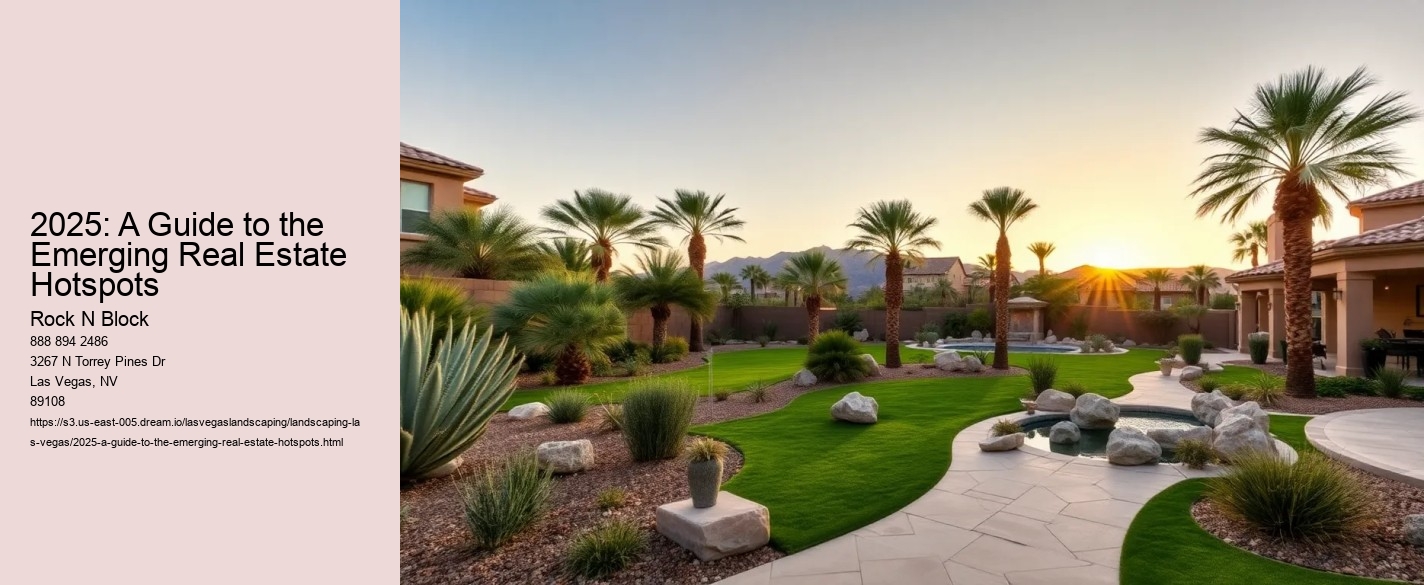
2025: A Guide to the Emerging Real Estate Hotspots

2025: A Guide to the Emerging Real Estate Hotspots

insured landscapers in Las Vegas

Welcoming Automation and Artificial Intelligence


Welcoming Automation and Artificial Intelligence to Make The Most Of Efficiency in 2025


As we come close to the year 2025, it is ending up being increasingly clear that automation and expert system (AI) are no more simply soaring principles and buzzwords, yet tangible tools that can change our performance and effectiveness. best Landscapers in Las Vegas Nevada. By embracing these technologies, we can unlock unmatched levels of efficiency and enhance our jobs for the future.


Automation takes over repeated tasks, maximizing our time to focus on higher-level responsibilities. For example, in business context, automation devices can manage organizing, client service, data access, and lots of other administrative tasks. The result is not just lowered labor expenses however likewise enhanced productivity as staff members can commit their time and energy to more critical, creative and value-adding jobs.


Expert system boosts automation to an entire brand-new degree.

2025: A Guide to the Emerging Real Estate Hotspots - insured landscapers in Las Vegas

  1. licensed landscapers Las Vegas NV
  2. desert landscaping for homes in Las Vegas
  3. top landscaping firms in Las Vegas
  4. luxury backyard landscaping Las Vegas NV
  5. Residential Landscaping Las Vegas
AI systems can find out, adapt, and choose separately, making them not simply tools, yet allies in our quest for effectiveness. For example, AI algorithms can assess large quantities of information a lot faster and precisely than any type of human, providing companies with useful understandings and forecasts. This enables even more informed decision-making, enhanced procedures, and boosted consumer experiences.


Moreover, the assimilation of AI and automation can produce smart automation systems efficient in self-improvement. These systems can learn from their blunders and continuously enhance their procedures, bring about an ever-increasing effectiveness.


However, embracing automation and AI does not mean getting rid of the human component. These technologies are devices that are indicated to boost human capabilities, not replace them. They can take over the mundane tasks and provide us with even more area to apply our imagination, important reasoning, and emotional intelligence - skills that are distinctively human and irreplaceable.

2025: A Guide to the Emerging Real Estate Hotspots - landscapers near North Las Vegas NV

  1. pet-friendly backyard landscaping Las Vegas
  2. Las Vegas water-wise landscaping
  3. top-rated landscape designers Las Vegas
  4. affordable backyard landscaping Las Vegas NV
  5. landscaping reviews Las Vegas NV


In order to profit of automation and AI, we need to prepare. This involves getting brand-new abilities and understanding, promoting a culture of constant learning, and adapting our mindset to this rapidly changing globe. We have to likewise attend to ethical and social problems related to these innovations, like work variation and privacy problems, by implementing thoughtful policies and policies.

Finally, as we expect optimizing our efficiency in 2025, it is necessary that we welcome automation and AI. These modern technologies hold tremendous potential to change our productivity and efficiency. Nonetheless, it is equally important that we approach them with a human-centered viewpoint - leveraging them as devices to enhance our capacities, while also resolving the going along with obstacles properly. As we navigate this interesting era of technological innovation, our success will hinge on our ability to

Leveraging Online and Increased Truth for Efficiency


Leveraging Online and Enhanced Reality for Performance in 2025


As we stand on the verge of a technological transformation, the advent of Digital Truth (VIRTUAL REALITY) and Augmented Reality (AR) guarantees to redefine our understanding of effectiveness and productivity. By 2025, leveraging these technologies will certainly be essential in optimizing efficiency across various industries, from organization and industry to education and learning and healthcare.


Online Reality, with its immersive, three-dimensional interface, will transform the way we work. With virtual reality, physical limitations become unnecessary. Virtual reality headsets can transport us to virtual offices, enabling remote job without losing the advantages of a physical work environment. Conferences can happen in online areas, getting rid of the requirement for traveling and its connected expenses and time.


In addition, training and growth, typically a resource-intensive procedure, can be changed by virtual reality. Complicated treatments, be it in medical surgical treatment or aircraft upkeep, can be practiced in a regulated and safe virtual environment. This not just enhances the finding out experience yet also considerably minimizes the price of training.

Increased Reality, on the various other hand, superimposes digital info onto the real life. In a specialist context, this indicates that data and analytics can be accessed and cooperated real-time. Picture an auto mechanic who can see the plan of an equipment overlaid on the real devices, or a seller who can envision the sales information on the production line itself. This combination of information into our prompt atmosphere will certainly improve decision-making processes, thereby enhancing performance.


In 2025, it is anticipated that AR and virtual reality will certainly be integral to wise home systems, enhancing energy usage, and automating household jobs. From pre-heating your oven on your commute home to readjusting lighting based upon ambient conditions, these modern technologies will certainly make our homes more energy-efficient and our lives more convenient.


Nonetheless, to make best use of performance with VR and AR, it is essential to address the difficulties that come with these modern technologies. Problems concerning personal privacy, information safety and security, and the digital divide must be addressed.

2025: A Guide to the Emerging Real Estate Hotspots - insured landscapers in Las Vegas

  1. Las Vegas front and backyard landscaping
  2. Las Vegas landscaping with artificial turf
  3. best landscaping companies in Las Vegas
  4. recommended landscaping contractors Las Vegas
  5. shade landscaping solutions Las Vegas
Additionally, the potential for over-dependence on technology and the following loss of human touch in communications is a substantial worry.


To conclude, by 2025, virtual reality and AR will certainly have the prospective to redefine efficiency in our personal and expert lives. Leveraging these modern technologies will certainly call for a careful balance of innovation and guideline. But with the best strategy, the virtual reality and AR revolution can lead us into a future where efficiency is not just about doing much more with much less, however concerning boosting the top quality of our work and our lives.

Adjusting to the Future of Remote Work


Adjusting to the Future of Remote Job: How to Optimize Your Efficiency in 2025

As we look in the direction of the future, it appears that the world of job is transforming. The standard office setting is making way for an extra versatile, remote working arrangement. By 2025, it is anticipated that a considerable section of the worldwide workforce will be working from another location, either permanent or part-time. This shift uses various benefits, consisting of boosted versatility and the possibility for a much healthier work-life balance. Nonetheless, it also presents special difficulties that call for efficient adaptation to maximize productivity and success.


In adjusting to the future of remote work, it is vital to first welcome the technological developments at our disposal. By 2025, we expect to see more developments in communication, cooperation, and project management tools. These technological developments will aid to link the gap developed by physical distance, guaranteeing groups can interact flawlessly no matter their area. As a result, remaining abreast with these technical changes and including them into our day-to-day operations is critical.


Secondly, we need to cultivate the right attitude. Remote work is not just about functioning from home; its concerning having the ability to work properly and successfully in a non-traditional environment. This calls for self-discipline, inspiration, and outstanding time monitoring abilities. Its concerning establishing the ability to separately handle your jobs and provide within due dates.


Finally, it is necessary to establish clear communication networks and protocols. With employee dispersed throughout different places and possibly time areas, clear and succinct communication is essential.

2025: A Guide to the Emerging Real Estate Hotspots - insured landscapers in Las Vegas

  1. insured landscapers in Las Vegas
  2. top backyard landscapers Las Vegas
  3. rock and gravel backyard design Las Vegas
  4. landscapers near North Las Vegas NV
  5. landscape lighting installation Las Vegas
Routine check-ins, feedback sessions and open lines of interaction can assist to ensure everyone gets on the exact same web page and functioning towards the exact same goals.


In 2025, we might also see a rise in the principle of coworking spaces. These shared work areas can offer the advantages of a standard office environment-- like face-to-face interaction and a feeling of area-- without the rigidity. Utilizing such rooms might help to deal with feelings of isolation or interference that some remote employees might experience.


Last but not least, its about accomplishing a work-life equilibrium. One of the biggest difficulties of remote work is the blurring of borders in between personal and expert life. It is crucial to produce clear delineations in between work and personal time to make sure both rounds of life are nurtured and neither is disregarded.


To conclude, as we adapt to the future of remote work, it is important to accept the technical advancements that facilitate this shift, cultivate the appropriate way of thinking, establish

Investing in Continual Learning and Skill Development


Investing in Continual Understanding and Skill Advancement: A Key to Maximize Your Efficiency in 2025


As we continue to browse via the 21st century, the dynamics of the international economy and the work environment continue to progress at an unprecedented rate. This quick adjustment, fueled by technological innovations and digitization, needs people to continuously upgrade their skills and knowledge. To optimize effectiveness and continue to be affordable in 2025 and past, buying continual discovering and skill advancement is no longer an option, but a need.


Continual learning is the process of continuously getting and upgrading all sort of capacities, expertise, and understandings from both formal and casual knowing experiences to promote individual and specialist development. It incorporates a large range of activities, including reading, participating in workshops and workshops, participating in online programs, and pursuing postgraduate degrees.


In the context of 2025, several elements make continuous understanding and ability advancement critical. First of all, the quick improvement of innovation, such as Expert System (AI), robotics, and machine learning, is interrupting traditional work duties and creating brand-new ones. To keep pace with these modifications, one should consistently update their abilities and understanding.

2025: A Guide to the Emerging Real Estate Hotspots - landscapers near North Las Vegas NV

  1. trusted Las Vegas landscaping professionals
  2. top-rated irrigation installers Las Vegas
  3. Las Vegas backyard fire pit landscaping
  4. landscaping near The Strip Las Vegas
  5. full-service landscaping Las Vegas NV


Secondly, the business landscape in 2025 is anticipated to be much more affordable and volatile. Continuous knowing makes it possible for individuals to adapt to these adjustments by equipping them with the necessary skills to deal with complex problems, make educated decisions, and introduce.


Thirdly, the COVID-19 pandemic has highlighted the relevance of versatility and resilience, which can be cultivated through continual understanding. The pandemic has accelerated the shift to remote job and digital systems, necessitating proficiency in digital skills and the capacity to swiftly adapt to new workplace.


As the nature of work progresses, soft skills such as psychological intelligence, critical thinking, and creative thinking become just as crucial. Constant knowing not only assists in improving these skills however also advertises a development mindset. This way of thinking, identified by the idea that capabilities and knowledge can be established, is important for thriving in the vibrant world of 2025.


In conclusion, purchasing continual discovering and skill development is essential for maximizing performance in 2025. It equips people with the essential technological and soft abilities, advertises flexibility and durability, and promotes a growth attitude. Amid the fast-paced technological and economic modifications, those who pick to be lifelong learners will certainly be better positioned to seize opportunities and browse challenges in the future. The future belongs to those that learn, unlearn, and relearn in a nonstop cycle of individual

Las Las vega, informally referred to as Vegas, is the most populous city in the U. S. state of Nevada and the area seat of Clark Region. The Las Las vega Valley metropolitan area is the biggest within the greater Mojave Desert, and second-largest in the Southwestern USA. According to the United States Census Bureau, the city had 641,903 residents in 2020, with a cosmopolitan population of 2,227,053, making it the 24th-most populated city in the USA. Las Vegas is an internationally distinguished significant resort city, known mainly for its gambling, shopping, fine eating, enjoyment, and nightlife. It has most locations centered on downtown Las Vegas and even more to the Las Vegas Strip, located outdoors city limits in the unincorporated communities of Heaven and Winchester. The Las Las vega Valley serves as the leading monetary, business, and cultural facility in Nevada. Las Las vega was settled in 1905 and formally integrated in 1911. At the close of the 20th century, it was one of the most inhabited North American city established within that century (a similar distinction was earned by Chicago in the 19th century). Population development has sped up considering that the 1960s and right into the 21st century, and between 1990 and 2000 the population raised by 85. 2%. The city expenses itself as the Entertainment Capital of the Globe, and is well-known for its glamorous and big casino-hotels. As of 2023, Las Vegas attracts over 40. 8 million site visitors every year, making it one of the most visited cities in the USA and regularly ranking among the globe's top tourist destinations. It is the third most prominent U. S. location for company conventions and a global leader in the friendliness industry. The city's resistance for countless kinds of grown-up amusement has made it the label "Transgression City", and has made it a popular setting for films, literature, television programs, commercials and music videos.

.
Landscaping an elementary school courtyard in the city of Kuching

Landscaping refers to any activity that modifies the visible features of an area of land, including the following:

  1. Living elements, such as flora or fauna; or what is commonly called gardening, the art and craft of growing plants with a goal of creating a beauty within the landscape.
  2. Natural abiotic elements, such as landforms, terrain shape and elevation, or bodies of water.
  3. Abstract elements, such as the weather and lighting conditions.

Landscaping requires a certain understanding of horticulture and artistic design, but is not limited to plants and horticulture. Sculpting land to enhance usability (patio, walkways, ponds, water features) are also examples of landscaping being used. When intended as purely an aesthetic change, the term Ornamental Landscaping is used.[1]

Often, designers refer to landscaping as an extension of rooms in your house (each one has a function). Outdoor spaces have a vast amount of flexibility as far as materials and function. It is often said the only limitation to outdoor space is one's imagination.

Understanding the land

[edit]

Construction requires both study and observation, and the process varies in different parts of the world. Landscaping varies according to different regions.[2] Therefore, normally local natural experts are recommended if it is done for the first time. Understanding of the site is one of the chief essentials for successful landscaping.[3] Different natural features and phenomena, like the position of the sun, terrain, topography, soil qualities, prevailing winds, depth of the frost line, and the system of native flora and fauna must be taken into account.[4] Sometimes the land is not fit for landscaping. In order to landscape it, the land must be reshaped to direct water for appropriate drainage. This reshaping of land is called grading.[4] Sometimes in large landscaping projects like, parks, sports fields and reserves soil may need to be improved by adding nutrients for growth of plants or turf, this process is called soil amelioration.[5]

Removal of earth from the land is called cutting while when earth is added to the slope, it is called filling. Sometimes the grading process may involve removal of excessive waste (landfills), soil and rocks, so designers should take into account while in the planning stage.[6][7]

Additional information

[edit]

At the start, the landscaping contractor issues a statement which is a rough design and layout of what could be done with the land in order to achieve the desired outcome.[4] Different pencils are required to make graphics of the picture. Landscaping has become more technological than natural, as few projects begin without bulldozers, lawnmowers, or chainsaws.[2] Different areas have different qualities of plants. When growing new grass, it should ideally be done in the spring and the fall seasons to maximize growth and to minimize the spread of weeds. It is generally agreed that organic or chemical fertilizers are required for good plant growth. Some landscapers prefer to use mix gravel with rocks of varying sizes to add interest in large areas.[8]

See also

[edit]

References

[edit]
  1. ^ "What is ornamental landscaping?". NatraTex. Retrieved 2022-03-30.
  2. ^ a b Diekelmann, John; Schuster, Robert M. (2002). Natural Landscaping: Designing with Native Plant Communities. University of Wisconsin Press. ISBN 978-0-299-17324-1.
  3. ^ James, Сarolyn (July 14, 2020). "Landscaping Challenges". Archived from the original on 2021-05-13.
  4. ^ a b c Ingels, Jack (2009). Landscaping Principles and Practices. Cengage Learning. ISBN 978-1-4283-7641-0.
  5. ^ "Soil Preparation Steps For Successful Landscape Projects". chandlerlandscapeing.com. 2024-12-22. Retrieved 2024-12-22.
  6. ^ Slack, William (1998). Landscaping. Oxmoor House. ISBN 978-0-8487-2251-7.
  7. ^ Buchanan, Rita (2000). Taylor's Master Guide to Landscaping. Houghton Mifflin Harcourt. ISBN 0-618-05590-8.
  8. ^ Sharon Cohoon and Jim McCausland. "How to Landscape Gravel". Sunset.com. Archived from the original on 2020-01-31. Retrieved 2013-04-10.
[edit]


Sustainable landscaping is a modern type of gardening or landscaping that takes the environmental issue of sustainability into account. According to Loehrlein in 2009 this includes design, construction and management of residential and commercial gardens and incorporates organic lawn management and organic gardening techniques.[1]

Definition

[edit]

A sustainable garden is designed to be both attractive and in balance with the local climate and environment and it should require minimal resource inputs. Thus, the design must be “functional, cost-efficient, visually pleasing, environmentally friendly and maintainable".[2] As part of sustainable development, it pays close attention to preserving limited resources, reducing waste, and preventing air, water and soil pollution. Compost, fertilization, integrated pest management, using the right plant in the right place, appropriate use of turf and xeriscaping (water-wise gardening) are all components of sustainable landscaping.

Benefits

[edit]

Sustainability can help urban commercial landscaping companies save money.[3] In California, gardens often do not outweigh the cost of inputs like water and labor. However, using appropriately selected and properly sited plants may help to ensure that maintenance costs are lower because of reduced inputs.

Issues

[edit]

Sustainability issues for landscaping include:

Non-sustainable practices include:

Solutions

[edit]

Some of the solutions are:

Proper design

[edit]

One step to garden design is to do a "sustainability audit". This is similar to a landscape site analysis that is typically performed by landscape designers at the beginning of the design process. Factors such as lot size, house size, local covenants and budgets should be considered. The steps to design include a base plan, site inventory and analysis, construction documents, implementation and maintenance.[2] Of great importance is considerations related to the growing conditions of the site. These include orientation to the sun, soil type, wind flow, slopes, shade and climate, the goal of reducing irrigation and use of toxic substances, and requires proper plant selection for the specific site.

Sustainable landscaping is not only important because it saves money, it also limits the human impact on the surrounding ecosystem. However, planting species not native to the landscape may introduce invasive plant species as well as new wildlife that was not in the ecosystem before. Altering the ecosystem is a major problem and meeting with an expert with experience with the wildlife and agriculture in the area will help avoid this.[26]

Irrigation

[edit]

Mulch may be used to reduce water loss due to evaporation, reduce weeds, minimize erosion, dust and mud problems. Mulch can also add nutrients to the soil when it decomposes. However, mulch is most often used for weed suppression. Overuse of mulch can result in harm to the selected plantings. Care must be taken in the source of the mulch, for instance, black walnut trees result in a toxic mulch product. Grasscycling turf areas (using mulching mowers that leave grass clippings on the lawn) will also decrease the amount of fertilizer needed, reduce landfill waste and reduce costs of disposal.[27]

A common recommendation is to add 2-4 inches of mulch in flower beds and under trees away from the trunk. Mulch should be applied under trees to the dripline (extension of the branches) in lieu of flowers, hostas, turf or other plants that are often planted there. This practice of planting under trees is detrimental to tree roots, especially when such plants are irrigated to an excessive level that harms the tree. One must be careful not to apply mulch to the bark of the tree. It can result in smothering, mould and insect depredation.

The practice of xeriscaping or water-wise gardening suggests that placing plants with similar water demands together will save time and low-water or drought-tolerant plants would be a smart initial consideration.

A homeowner may consider consulting an accredited irrigation technician/auditor and obtain a water audit of current systems. Drip or sub-surface irrigation may be useful. Using evapotranspiration controllers, soil sensors and refined control panels will reduce water loss. Irrigation heads may need readjustment to avoid sprinkling on sidewalks or streets. Business owners may consider developing watering schedules based on historical or actual weather data and soil probes to monitor soil moisture prior to watering.[2]

An example of sustainable irrigation (Drip Irrigation)

Building materials

[edit]

When deciding what kind of building materials to put on a site it is important to recycle as often as possible, such as for example by reusing old bricks.

It is also important to be careful about what materials you use, especially if you plan to grow food crops. Old telephone poles and railroad ties have usually been treated with a toxic substance called creosote that can leach into the soils.

Sustainably harvested lumber is available, in which ecological, economic and social factors are integrated into the management of trees used for lumber.[28]

Planting selection

[edit]

One important part of sustainable landscaping is plant selection. Most of what makes a landscape unsustainable is the amount of inputs required to grow a non-native plant on it. What this means is that a local plant, which has adapted to local climate conditions will require less work to flourish. Instead, drought-tolerant plants like succulents and cacti are better suited to survive.

Plants used as windbreaks can save up to 30% on heating costs in winter. They also help with shading a residence or commercial building in summer, create cool air through evapotranspiration and can cool hardscape areas such as driveways and sidewalks.[29]

Irrigation is an excellent end-use option in greywater recycling and rainwater harvesting systems, and a composting toilet can cover (at least) some of the nutrient requirements.[30] Not all fruit trees are suitable for greywater irrigation, as reclaimed greywater is typically of high pH and acidophile plants don't do well in alkaline environments.

Energy conservation may be achieved by placing broadleaf deciduous trees near the east, west and optionally north-facing walls of the house. Such selection provides shading in the summer while permitting large amounts of heat-carrying solar radiation to strike the house in the winter. The trees are to be placed as closely as possible to the house walls. As the efficiency of photovoltaic panels and passive solar heating is sensitive to shading, experts suggest the complete absence of trees near the south side.

Another choice would be that of a dense vegetative fence composed of evergreens (e.g. conifers) near that side from which cold continental winds blow and also that side from which the prevailing winds blow. Such a choice creates a winter windbreak that prevents low temperatures outside the house and reduces air infiltration towards the inside. Calculations show that placing the windbreak at a distance twice the height of the trees can reduce the wind velocity by 75%.[31]

The above vegetative arrangements come with two disadvantages. Firstly, they minimize air circulation in summer although in many climates heating is more important and costly than cooling, and, secondly, they may affect the efficiency of photovoltaic panels. However, it has been estimated that if both arrangements are applied properly, they can reduce the overall house energy usage by up to 22%.[31]

Sustainable lawns

[edit]
An example of a sustainable lawn

Lawns are often used as the center point of a landscape. While there are many different species of grass, only a limited amount are considered sustainable. Knowing the climate around the landscape is ideal for saving water and being sustainable. For example, in southern California having a grass lawn of tall fescue will typically need upwards of 1,365 cubic metres (360,500 US gal) of water. A lawn in the same place made up of mixed beds with various trees, shrubs, and ground cover will normally need 202 cubic metres (53,300 US gal) of water.[32] Having gravel, wood chips or bark, mulch, rubber mulch, artificial grass, patio, wood or composite deck, rock garden, or a succulent garden are all considered sustainable landscape techniques. Other species of plants other than grass that can take up a lawn are lantana, clover, creeping ivy, creeping thyme, oregano, rosemary hedges, silver pony foot, moneywort, chamomile, yarrow, creeping lily turf, ice plant, and stonecrop.[citation needed]

Urban environments

[edit]

In urban settings, sustainable landscaping strategies often require innovative approaches due to limited space and high population density. Techniques such as incorporating synthetic turf can reduce water usage while maintaining green aesthetics. Additionally, vertical gardens, rooftop greenery, and permeable paving systems are increasingly used to combat urban heat islands and improve stormwater management. These practices not only enhance environmental performance but also contribute to the mental and physical well-being of urban residents by integrating nature into densely built environments. [33]

Maintenance

[edit]

Pests

[edit]

It is best to start with pest-free plant materials and supplies and close inspection of the plant upon purchase is recommended. Establishing diversity within the area of plant species will encourage populations of beneficial organisms (e.g. birds, insects), which feed on potential plant pests. Attracting a wide variety of organisms with a variety of host plants has shown to be effective in increasing pollinator presence in agriculture.[34] Because plant pests vary from plant to plant, assessing the problem correctly is half the battle. The owner must consider whether the plant can tolerate the damage caused by the pest. If not, then does the plant justify some sort of treatment? Physical barriers may help.[2] Landscape managers should make use of Integrated Pest Management to reduce the use of pesticides and herbicides.

Pruning

[edit]

Proper pruning will increase air circulation and may decrease the likelihood of plant diseases. However, improper pruning is detrimental to shrubs and trees.[2]

Programs

[edit]

There are several programs in place that are open to participation by various groups. For example, the Audubon Cooperative Sanctuary Program for golf courses,[35] the Audubon Green Neighborhoods Program,[36] and the National Wildlife Federation’s Backyard Habitat Program,[37] to name a few.

The Sustainable Sites Initiative, began in 2005, provides a points-based certification for landscapes, similar to the LEED program for buildings operated by the Green Building Council. It has guidelines and performance benchmarks.[38]

See also

[edit]

References

[edit]
  1. ^ Loehrlein, Marietta (26 September 2013). Sustainable Landscaping: Principles and Practices. CRC Press. ISBN 9781466593206. Editor note: info in Wikipedia taken in November 2009 from her now defunct personal website and a class she gave on her former university webspace
  2. ^ a b c d e Colorado State University Extension. http://www.ext.colostate.edu/Pubs/Garden/07243.html. Viewed 11-15-09.
  3. ^ Buiten, Tim (19 October 2020). "Commercial Landscape Management: How to Maximize Your ROI". Tim's Complete. Retrieved 28 October 2020.
  4. ^ "Sustainable Landscapes and its Benefits – Debating Science". Retrieved 2019-11-21.
  5. ^ Rowe, B., J. Andersen, J. Lloyd, T. Mrozowski and K. Getter. The green roof research at Michigan State University. http://hrt.msu.edu/greenroof/ Viewed 7/30/2007.
  6. ^ Robinette, G. O. and K. W. Sloan. 1984. Water conservation in landscape design and management. Van Nostrand Reinhold Co. NY. 258pp.
  7. ^ PennState Center for Green Roof Research. http://web.me.com/rdberghage/Centerforgreenroof/Home.html. Viewed 9/23/09.
  8. ^ Carver, S. 2008. Water-wise landscaping can improve conservation efforts. Landscape Mgmt. May/June Suppl Livescapes. P. 8.
  9. ^ Eberle, W. M. and J. G. Thomas. 1981. Some water-saving ways. Kansas State Ext. 4pp.
  10. ^ Krizner, K. 2008. Smart water solutions. Landscape Management May/June. p. 31-2
  11. ^ White, J.D. 2008. When the well runs dry: managing water before it becomes a crisis. GrowerTalks. Aug. pp. 42-43.
  12. ^ Campbell, C. S. and M. H. Ogden. Constructed wetlands in the sustainable landscape. 1999. Wiley & Sons. NY. 270pp.
  13. ^ Melby, P. and T. Cathcart 2002. Regenerative design techniques : practical applications in landscape design. Wiley. New York. 410 p.
  14. ^ Harker, D., G. Libby. Harker, K. Evans, S. Evans, M. 1999. Landscape Restoration Handbook, 2nd ed. Lewis Publishers. Boca Raton. 865pp.
  15. ^ Fizzell, J. A. 1983. Landscape designers must put energy conservation in their plans. Amer. Nurseryman. 157:65-71.
  16. ^ Pitt, D. G. J. Kissida and W. Gould. 1980. How to design a windbreak residential landscaping. Amer. Nurseryman. Vol. 152(10): 10-11.
  17. ^ Interlocking Concrete Pavement Institute. Permeable interlocking concrete pavement: a comparison guide to porous asphalt and pervious concrete. http://www.icpi.org/myproject/PICP%20Comparison%20Brochure.pdf. Viewed June 2008.
  18. ^ Kerkhoff, K. L. 2006. How to capitalize and reduce stormwater runoff in your landscapes. Grounds Maint. P. 70.
  19. ^ Thompson,W. J., K. Sorvig and Farnsworth, C. D. 2000. "Sustainable Landscape Construction". Island Pr. Washington, D.C. 348p.
  20. ^ EPA. 1998. Landscaping products containing recovered materials. USEPA Solid Waste and Emergency Response. 8pp.
  21. ^ Bramwell, J. 2006. Power with a conscience. Amer. Nurseryman. 203(3):33-37.
  22. ^ "Lawn Reform Coalition". Archived from the original on March 5, 2010.
  23. ^ "5 Water-Saving Ways to Replace Lawns During California's Drought". 2015-05-21. Archived from the original on May 24, 2015.
  24. ^ "Outgrowing the Traditional Grass Lawn".
  25. ^ "Meadows and Prairies: Wildlife-Friendly Alternatives to Lawn".
  26. ^ "Benefits Of Sustainable Landscaping". elite-horticulture. Retrieved 2019-11-19.
  27. ^ California Integrated Waste Management Board. http://www.ciwmb.ca.gov/Organics/landscaping/
  28. ^ http://www.bearcreeklumber.com/products/intextboth/sustainable.html. Viewed 12-07-09.
  29. ^ Farmstead Windbreaks: Planning. http://www.extension.iastate.edu/Publications/PM1716.pdf. Retrieved 12-12-09.
  30. ^ Ghaly, Abdelkader (July 2021). "Greywater Sources, Characteristics, Utilization and Management Guidelines: a review". Research Article.
  31. ^ a b "Green from the ground up" by D. Johnston and S. Gibson
  32. ^ Pittenger M.S, Dennis (2014). "KEEPING LANDSCAPES GREEN WITH LESS GREEN" (PDF). cite journal: Cite journal requires |journal= (help)
  33. ^ Burnett, Tyler (2025-04-24). "Sustainable Landscaping in Urban Environments: Innovative Approaches for Greener Cities". Goat Turf. Retrieved 2025-05-09.
  34. ^ Cole, Lorna J.; Brocklehurst, Sarah; Robertson, Duncan; Harrison, William; McCracken, David I. (December 2015). "Riparian buffer strips: Their role in the conservation of insect pollinators in intensive grassland systems". Agriculture, Ecosystems & Environment. 211: 207–220. Bibcode:2015AgEE..211..207C. doi:10.1016/j.agee.2015.06.012. ISSN 0167-8809.
  35. ^ http://Audubon International. acspgolf.auduboninternational.org/. Viewed 9/23/09.
  36. ^ Green Neighborhoods http://gn.auduboninternational.org/. Viewed 9/23/09
  37. ^ Garden for Wildlife. http://www.nwf.org/gardenforwildlife/certify.cfm?campaignid=WH09KLBR. Viewed 9/23/09.
  38. ^ The Sustainable Sites Initiative. http://www.sustainablesites.org/report/SSI_Guidelines_Draft_2008.pdf. Viewed 9/23/09.


Driving Directions in Clark County


Driving Directions From NV Landscapes LLC to
Driving Directions From Landscape Creations to
Driving Directions From Northwest Landscape & Maintenance to
Driving Directions From New horizon landscapes to
Driving Directions From Living Water Landscapes LV to
Driving Directions From Rock N Block - Turf N Hardscapes to
Driving Directions From Las Vegas Backyards to
Driving Directions From Taylormade Landscapes, LLC to
Driving Directions From Visualized Landscape to
Driving Directions From Ugarte Landscapes & Irrigation Repair to
Driving Directions From Custom Touch Landscape to
Driving Directions From Jr's Lawn Maintenance LLC. Irrigation contractor to
Driving Directions From South Point Hotel Casino & Spa to
Driving Directions From Four Queens Hotel & Casino to
Driving Directions From Golden Gate Hotel & Casino to
Driving Directions From Fremont Street Experience to
Driving Directions From Ethel M Chocolates Factory & Cactus Garden to
Driving Directions From Suncoast Hotel and Casino to
Driving Directions From Wynn Las Vegas to
Driving Directions From Red Rock Canyon National Conservation Area to
Driving Directions From Flamingo Las Vegas to
Driving Directions From Encore Las Vegas to

Reviews for Rock N Block Turf N Hardscapes


Rob Foster

(5)

We have been working with Al and the team for many years (8) to be exact. We have had the pleasure of working with many of their clients throughout this time and we absolutely love how their clients are so pleased with the work they do and the outcome of the projects! The sales team and staff have been very supportive and professional and that’s hard to come by. We look forward to many more years of this partnership with a very positive and motivated company that’s always looking out for the best interests of the community!

Dawna OgleYohe

(5)

My initial contact was with Ray, whom did an excellent job giving me an estimate on what I wanted done in my small yard and walkway., the guys that came out and did the work were superior. They did an excellent job. I’m very pleased with this company. I will highly recommend them to family and friends, and I will be using them in the near future for other little projects.

https://www.google.com/maps/reviews/data=!4m8!14m7!1m6!2m5!1sChZDSUhNMG9nS0VJQ0FnSUMzOGZld2ZBEAE!2m1!1s0x0:0x19c06675a06c11f!3m1!1s2@1:CIHM0ogKEICAgIC38fewfA%7CCgwI27q6uQYQuIGqqQE%7C?hl=en-US

https://www.google.com/maps/reviews/data=!4m8!14m7!1m6!2m5!1sChZDSUhNMG9nS0VJQ0FnSURYckktT2VREAE!2m1!1s0x0:0x19c06675a06c11f!3m1!1s2@1:CIHM0ogKEICAgIDXrI-OeQ%7CCgwI8v-5uQYQwNC54gI%7C?hl=en-US

https://www.google.com/maps/reviews/data=!4m8!14m7!1m6!2m5!1sChZDSUhNMG9nS0VJQ0FnSURmcmFTX2J3EAE!2m1!1s0x0:0x19c06675a06c11f!3m1!1s2@1:CIHM0ogKEICAgIDfraS_bw%7CCgwI1PP9uwYQqKP98AE%7C?hl=en-US

https://www.google.com/maps/reviews/data=!4m8!14m7!1m6!2m5!1sChZDSUhNMG9nS0VJQ0FnSUNuLWJTWWZnEAE!2m1!1s0x0:0x19c06675a06c11f!3m1!1s2@1:CIHM0ogKEICAgICn-bSYfg%7CCgsI9OTbtwYQ2O-gbA%7C?hl=en-US

https://www.google.com/maps/reviews/data=!4m8!14m7!1m6!2m5!1sChZDSUhNMG9nS0VJQ0FnSUQ3b3NYMENBEAE!2m1!1s0x0:0x19c06675a06c11f!3m1!1s2@1:CIHM0ogKEICAgID7osX0CA%7CCgwI2ImetgYQyNOA-QI%7C?hl=en-US

https://www.google.com/maps/reviews/data=!4m8!14m7!1m6!2m5!1sChdDSUhNMG9nS0VJQ0FnTURvbmRMQ29nRRAB!2m1!1s0x0:0x19c06675a06c11f!3m1!1s2@1:CIHM0ogKEICAgMDondLCogE%7CCgwIrpi6wAYQ-M-VygE%7C?hl=en-US

https://www.google.com/maps/reviews/data=!4m8!14m7!1m6!2m5!1sChdDSUhNMG9nS0VJQ0FnTUNJb0pMdXJRRRAB!2m1!1s0x0:0x19c06675a06c11f!3m1!1s2@1:CIHM0ogKEICAgMCIoJLurQE%7CCgsIk9yfvwYQ6NyVNQ%7C?hl=en-US

https://www.google.com/maps/reviews/data=!4m8!14m7!1m6!2m5!1sChdDSUhNMG9nS0VOT3VpTmo3ODRxTTJ3RRAB!2m1!1s0x0:0x19c06675a06c11f!3m1!1s2@1:CIHM0ogKENOuiNj784qM2wE%7CCgwIpa-BwgYQ4Jba0wI%7C?hl=en-US

View GBP