Meeting-room audio / planning notebook
Build a large meeting room sound plan before choosing speakers
Last updated:
Large meeting spaces need speaker selection based on room layout and coverage rather than volume alone. Consider seating distance, reflective surfaces, microphone placement, and the conferencing system’s connections. Check whether the equipment handles playback only or includes microphone and echo management functions. Distributed speakers or professional room design may be more appropriate than a single louder unit, depending on how the space is used.

Begin with how the large room actually speaks
Map who speaks from the table, the presentation area, and the perimeter seats. A room can be full without every voice being equally important, so separate discussion, presentations, and questions. The room brief for Begin with how the large room actually speaks converts a broad equipment question into named listeners, talkers, transitions, and failure points. The planning margin for Begin with how the large room actually speaks comes from ordinary occupied conditions, not a polished empty-room demonstration. Hold a short rehearsal with normal furniture, occupied chairs, and the doors in their usual position. Keep the Begin with how the large room actually speaks rehearsal anchored to its original room brief until the team can distinguish intelligibility from novelty or extra level. I use a current roundup of conference room speaker options as a shopping reference only after the room plan and acceptance questions are visible.
Record the quietest useful voice and the most distant listener instead of relying on a volume impression. The first purchase note should name the meeting pattern, not a preferred device category. A decision record for Begin with how the large room actually speaks keeps the starting configuration beside the observed result, so a later owner can separate system behavior from changed furniture, software, or meeting custom. Compare notes for Begin with how the large room actually speaks before discussing expectations, because conflicting results send the group back to the documented starting configuration and one disputed step.
- Observation to capture: Map who speaks from the table, the presentation area, and the perimeter seats.
- Test condition: Hold a short rehearsal with normal furniture, occupied chairs, and the doors in their usual position.
- Outcome to record: Record the quietest useful voice and the most distant listener instead of relying on a volume impression.
- Next decision: The first purchase note should name the meeting pattern, not a preferred device category.
Treat acoustics as part of the speaker decision
Listen for reflected speech after a sentence ends and for masking from ventilation, corridors, or equipment. Large glass walls, bare ceilings, and open partitions can change intelligibility more than an extra watt of output. The room brief for Treat acoustics as part of the speaker decision converts a broad equipment question into named listeners, talkers, transitions, and failure points. The planning margin for Treat acoustics as part of the speaker decision comes from ordinary occupied conditions, not a polished empty-room demonstration. Walk the room while one person reads a short agenda item at a normal conversational level. Keep the Treat acoustics as part of the speaker decision rehearsal anchored to its original room brief until the team can distinguish intelligibility from novelty or extra level.
Ask listeners to write the words they heard before they compare notes. Use the results to decide whether placement, absorption, or zoning needs attention before hardware is specified. A decision record for Treat acoustics as part of the speaker decision keeps the starting configuration beside the observed result, so a later owner can separate system behavior from changed furniture, software, or meeting custom. Compare notes for Treat acoustics as part of the speaker decision before discussing expectations, because conflicting results send the group back to the documented starting configuration and one disputed step.
- Observation to capture: Listen for reflected speech after a sentence ends and for masking from ventilation, corridors, or equipment.
- Test condition: Walk the room while one person reads a short agenda item at a normal conversational level.
- Outcome to record: Ask listeners to write the words they heard before they compare notes.
- Next decision: Use the results to decide whether placement, absorption, or zoning needs attention before hardware is specified.
Separate audience coverage from talker pickup
A far seat that cannot hear and a side seat that cannot be heard are different failures. Speaker placement distributes listening; microphone geometry determines whether remote people receive an intelligible contribution. The room brief for Separate audience coverage from talker pickup converts a broad equipment question into named listeners, talkers, transitions, and failure points. The planning margin for Separate audience coverage from talker pickup comes from ordinary occupied conditions, not a polished empty-room demonstration. Run a two-way call with a remote colleague rather than only playing music or a recorded clip. Keep the Separate audience coverage from talker pickup rehearsal anchored to its original room brief until the team can distinguish intelligibility from novelty or extra level.
Log the location of every repeat request, clipped start, and feedback event. Choose a system only after it answers both directions of the conversation. A decision record for Separate audience coverage from talker pickup keeps the starting configuration beside the observed result, so a later owner can separate system behavior from changed furniture, software, or meeting custom. Compare notes for Separate audience coverage from talker pickup before discussing expectations, because conflicting results send the group back to the documented starting configuration and one disputed step.
- Observation to capture: A far seat that cannot hear and a side seat that cannot be heard are different failures.
- Test condition: Run a two-way call with a remote colleague rather than only playing music or a recorded clip.
- Outcome to record: Log the location of every repeat request, clipped start, and feedback event.
- Next decision: Choose a system only after it answers both directions of the conversation.
Compare system shapes in operational terms
One integrated speakerphone may suit a focused table, while a distributed room may need dedicated microphones and loudspeakers. The useful distinction is not premium versus basic; it is which path stays understandable when the room is busy. The room brief for Compare system shapes in operational terms converts a broad equipment question into named listeners, talkers, transitions, and failure points. The planning margin for Compare system shapes in operational terms comes from ordinary occupied conditions, not a polished empty-room demonstration. Set up a simple comparison with identical call material and fixed listener positions. Keep the Compare system shapes in operational terms rehearsal anchored to its original room brief until the team can distinguish intelligibility from novelty or extra level.
Score outcomes by word recognition, handoff time, and how easily a facilitator can recover from a fault. Leave unknowns visible instead of averaging them into a single attractive score. A decision record for Compare system shapes in operational terms keeps the starting configuration beside the observed result, so a later owner can separate system behavior from changed furniture, software, or meeting custom. Compare notes for Compare system shapes in operational terms before discussing expectations, because conflicting results send the group back to the documented starting configuration and one disputed step.
- Observation to capture: One integrated speakerphone may suit a focused table, while a distributed room may need dedicated microphones and loudspeakers.
- Test condition: Set up a simple comparison with identical call material and fixed listener positions.
- Outcome to record: Score outcomes by word recognition, handoff time, and how easily a facilitator can recover from a fault.
- Next decision: Leave unknowns visible instead of averaging them into a single attractive score.
| System approach | Useful room condition | Question to test | Named owner |
|---|---|---|---|
| Integrated conference unit | Focused table with predictable seating | Can far-end seats both hear and be heard? | Meeting host |
| Expandable microphone-and-speaker system | Long table or changing attendance | Do extensions preserve natural handoffs? | AV support |
| Distributed room audio | Large, zoned, or partitioned room | Does each zone maintain intelligibility? | Facilities and AV |
| Integrated codec installation | Managed collaboration room | Does the standard call workflow recover cleanly? | IT and AV |
Scroll the table horizontally only if your screen is narrow.
Plan zones, cabling, and power before furniture settles
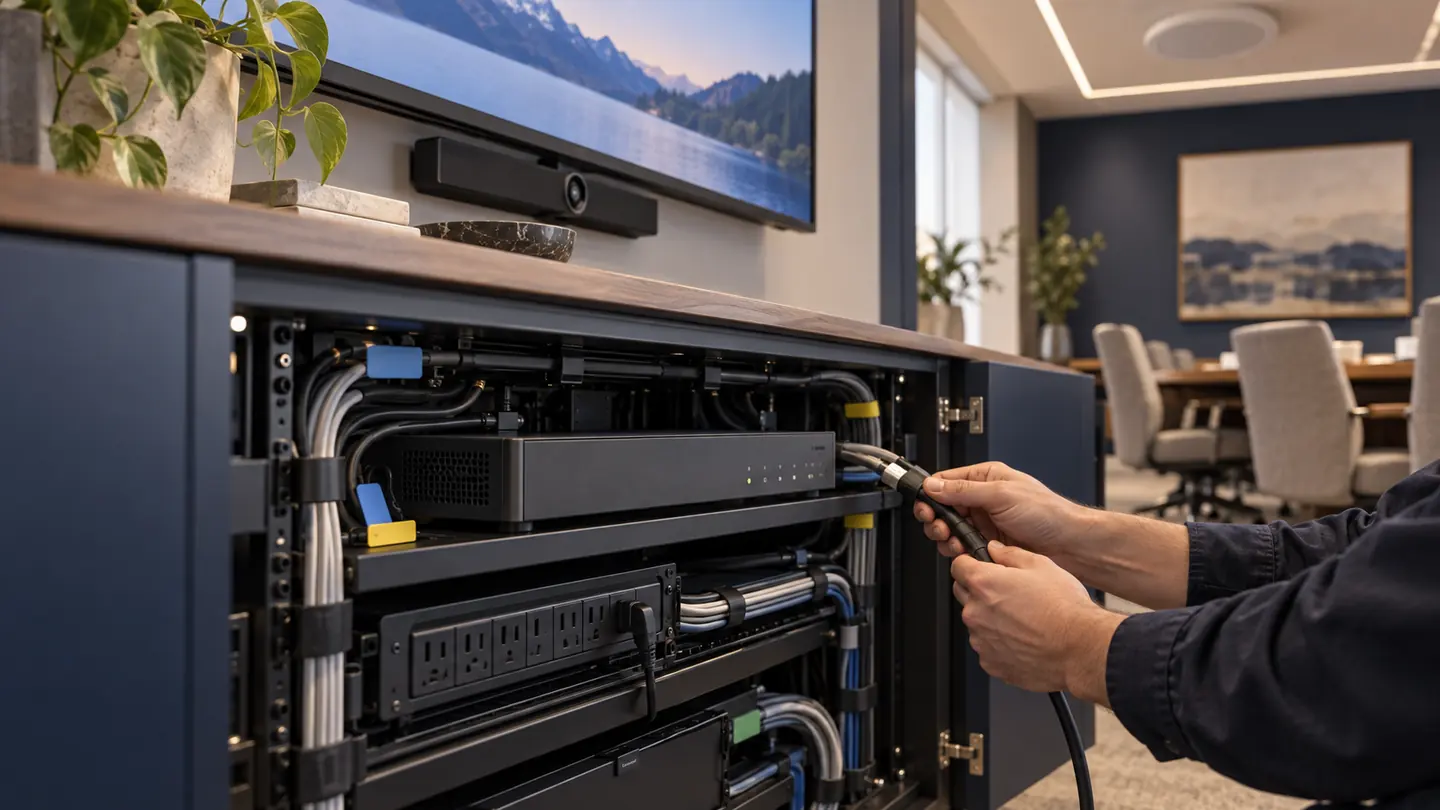
Speaker zones should follow listening areas and partitions, not decorative symmetry. Cable routes, power, network access, and accessible controls all become harder to change after the room is in service. The room brief for Plan zones, cabling, and power before furniture settles converts a broad equipment question into named listeners, talkers, transitions, and failure points. The planning margin for Plan zones, cabling, and power before furniture settles comes from ordinary occupied conditions, not a polished empty-room demonstration. Mark provisional equipment positions on a plan and walk the routes with facilities and AV owners. Keep the Plan zones, cabling, and power before furniture settles rehearsal anchored to its original room brief until the team can distinguish intelligibility from novelty or extra level.
Check reach, service access, cable protection, and whether a movable wall changes the acoustic boundary. Give each endpoint an owner and a plain identifier that survives a staffing change. A decision record for Plan zones, cabling, and power before furniture settles keeps the starting configuration beside the observed result, so a later owner can separate system behavior from changed furniture, software, or meeting custom. Compare notes for Plan zones, cabling, and power before furniture settles before discussing expectations, because conflicting results send the group back to the documented starting configuration and one disputed step.
- Observation to capture: Speaker zones should follow listening areas and partitions, not decorative symmetry.
- Test condition: Mark provisional equipment positions on a plan and walk the routes with facilities and AV owners.
- Outcome to record: Check reach, service access, cable protection, and whether a movable wall changes the acoustic boundary.
- Next decision: Give each endpoint an owner and a plain identifier that survives a staffing change.
Use the video-call path as the test condition
The goal is conversation over the platform people actually join, not an impressive local sound check. Echo cancellation, device selection, mute state, and camera framing can alter the practical result of a speaker decision. The room brief for Use the video-call path as the test condition converts a broad equipment question into named listeners, talkers, transitions, and failure points. The planning margin for Use the video-call path as the test condition comes from ordinary occupied conditions, not a polished empty-room demonstration. Join a normal meeting service from a room computer and a separate remote device. Keep the Use the video-call path as the test condition rehearsal anchored to its original room brief until the team can distinguish intelligibility from novelty or extra level.
Test talker handoffs, screen sharing, remote interruption, and a host leaving then rejoining. Document the recovery steps beside the room controls rather than storing them only in an installer record. A decision record for Use the video-call path as the test condition keeps the starting configuration beside the observed result, so a later owner can separate system behavior from changed furniture, software, or meeting custom. Compare notes for Use the video-call path as the test condition before discussing expectations, because conflicting results send the group back to the documented starting configuration and one disputed step.
- Observation to capture: The goal is conversation over the platform people actually join, not an impressive local sound check.
- Test condition: Join a normal meeting service from a room computer and a separate remote device.
- Outcome to record: Test talker handoffs, screen sharing, remote interruption, and a host leaving then rejoining.
- Next decision: Document the recovery steps beside the room controls rather than storing them only in an installer record.
Protect the room from feedback and competing audio
Feedback is usually a boundary problem between microphones, loudspeakers, gain, and room reflections. A secondary display, hallway source, or laptop speaker can confuse the sound field even when primary equipment is correct. The room brief for Protect the room from feedback and competing audio converts a broad equipment question into named listeners, talkers, transitions, and failure points. The planning margin for Protect the room from feedback and competing audio comes from ordinary occupied conditions, not a polished empty-room demonstration. Introduce one variable at a time while an observer watches the system meters and another sits at the far end. Keep the Protect the room from feedback and competing audio rehearsal anchored to its original room brief until the team can distinguish intelligibility from novelty or extra level.
Note the threshold where a clear signal becomes harsh, hollow, or unstable. Prefer a stable, understandable setting to a dramatic maximum volume. A decision record for Protect the room from feedback and competing audio keeps the starting configuration beside the observed result, so a later owner can separate system behavior from changed furniture, software, or meeting custom. Compare notes for Protect the room from feedback and competing audio before discussing expectations, because conflicting results send the group back to the documented starting configuration and one disputed step.
- Observation to capture: Feedback is usually a boundary problem between microphones, loudspeakers, gain, and room reflections.
- Test condition: Introduce one variable at a time while an observer watches the system meters and another sits at the far end.
- Outcome to record: Note the threshold where a clear signal becomes harsh, hollow, or unstable.
- Next decision: Prefer a stable, understandable setting to a dramatic maximum volume.
Pilot the difficult seats and moments
A central chair is a poor proxy for a long table, movable seating, or people who speak from a wall display. The pilot should include side conversations returning to the group, questions from the rear, and a remote participant speaking first. The room brief for Pilot the difficult seats and moments converts a broad equipment question into named listeners, talkers, transitions, and failure points. The planning margin for Pilot the difficult seats and moments comes from ordinary occupied conditions, not a polished empty-room demonstration. Use a short agenda with named transitions so the same sequence can be repeated after a change. Keep the Pilot the difficult seats and moments rehearsal anchored to its original room brief until the team can distinguish intelligibility from novelty or extra level.
Capture who could hear, who had to repeat, and what the operator did to recover. Approve a layout from observed behavior rather than a demonstration at the easiest seat. A decision record for Pilot the difficult seats and moments keeps the starting configuration beside the observed result, so a later owner can separate system behavior from changed furniture, software, or meeting custom. Compare notes for Pilot the difficult seats and moments before discussing expectations, because conflicting results send the group back to the documented starting configuration and one disputed step.
- Observation to capture: A central chair is a poor proxy for a long table, movable seating, or people who speak from a wall display.
- Test condition: Use a short agenda with named transitions so the same sequence can be repeated after a change.
- Outcome to record: Capture who could hear, who had to repeat, and what the operator did to recover.
- Next decision: Approve a layout from observed behavior rather than a demonstration at the easiest seat.
Assign ownership for ordinary changes
Room audio degrades quietly when a cable is moved, a software update changes a device name, or someone alters gain to solve one meeting. A small ownership model gives facilities, IT, and meeting hosts separate but visible responsibilities. The room brief for Assign ownership for ordinary changes converts a broad equipment question into named listeners, talkers, transitions, and failure points. The planning margin for Assign ownership for ordinary changes comes from ordinary occupied conditions, not a polished empty-room demonstration. List the normal state, the permitted adjustments, and the escalation contact at the point of use. Keep the Assign ownership for ordinary changes rehearsal anchored to its original room brief until the team can distinguish intelligibility from novelty or extra level.
Review the list after furniture changes, room bookings change, or a recurring complaint appears. A clear maintenance boundary prevents every audio problem from becoming an urgent mystery. A decision record for Assign ownership for ordinary changes keeps the starting configuration beside the observed result, so a later owner can separate system behavior from changed furniture, software, or meeting custom. Compare notes for Assign ownership for ordinary changes before discussing expectations, because conflicting results send the group back to the documented starting configuration and one disputed step.
- Observation to capture: Room audio degrades quietly when a cable is moved, a software update changes a device name, or someone alters gain to solve one meeting.
- Test condition: List the normal state, the permitted adjustments, and the escalation contact at the point of use.
- Outcome to record: Review the list after furniture changes, room bookings change, or a recurring complaint appears.
- Next decision: A clear maintenance boundary prevents every audio problem from becoming an urgent mystery.

Make the decision record usable next year
A useful decision record explains what the room was required to do, what was tested, and which assumptions remain conditional. It should be short enough for a new room owner to understand during an incident. The room brief for Make the decision record usable next year converts a broad equipment question into named listeners, talkers, transitions, and failure points. The planning margin for Make the decision record usable next year comes from ordinary occupied conditions, not a polished empty-room demonstration. Keep the seating map, trial notes, configuration baseline, and vendor materials together in one controlled location. Keep the Make the decision record usable next year rehearsal anchored to its original room brief until the team can distinguish intelligibility from novelty or extra level.
Add a future review date after an important furniture, platform, or capacity change. The record turns a speaker choice into an adjustable room plan rather than a one-time purchase. A decision record for Make the decision record usable next year keeps the starting configuration beside the observed result, so a later owner can separate system behavior from changed furniture, software, or meeting custom. Compare notes for Make the decision record usable next year before discussing expectations, because conflicting results send the group back to the documented starting configuration and one disputed step.
- Observation to capture: A useful decision record explains what the room was required to do, what was tested, and which assumptions remain conditional.
- Test condition: Keep the seating map, trial notes, configuration baseline, and vendor materials together in one controlled location.
- Outcome to record: Add a future review date after an important furniture, platform, or capacity change.
- Next decision: The record turns a speaker choice into an adjustable room plan rather than a one-time purchase.
Large-room decision checklist
- The room map identifies remote listeners, far seats, standing positions, and changeable boundaries.
- Speech clarity is tested locally and through the usual conferencing path.
- Controls, zones, power, service access, and fallback steps have named owners.
- The baseline can be repeated after a room, platform, or capacity change.
Move From Meeting Rooms to Laptop Support
Room speakers serve shared audio needs rather than individual furniture needs. The next guide changes focus to portable laptop desks for use with couches and recliners.